While the claim file is organized, tracked, and searchable the review of that file lives in a folder nobody can find or a spreadsheet no one can access.

Most audit programs produce good work. The findings are real. The reviewers are skilled. The report is thorough.
And then it disappears.
The findings land in a PDF. The PDF goes into an email. The email goes into a folder. The folder gets named something different than the last one. Six months later, a new audit team starts over. The prior findings aren’t referenced. The agreed remediation isn’t checked. The trajectory, improvement or the absence of it, is invisible.
The audit program has no address. There is no place where the work lives, accumulates, and becomes organizational knowledge.
That is the system-of-record problem. And it is why most audit programs can’t fulfill their operational mandate, even when they’re trying to.
Three Conversations. Same Problem.
A Chief Claims Officer has a forty-seven-page audit report in front of her. It’s thorough. The findings are real. She’s seen most of them before.
“The problem isn’t the quality of the audit,” she says. “It’s that there’s no mechanism for a finding to become a living obligation. We issue it, the adjuster reads it, and then it ceases to exist as an operational object. It just becomes history.”
A VP of TPA Oversight is managing eleven relationships. Eleven different report formats. No way to see which TPAs are improving and which aren’t. No record of what any of them committed to last time.
“I’m not doing oversight,” he says. “I’m doing archaeology. Every quarter I’m digging through old PDFs trying to reconstruct a story that should already be sitting in a dashboard.”
A reinsurance claims director is trying to get a read on reserve adequacy across eight cedents. Each one runs its own audit program — different timing, different criteria, different formats.
“I’m making treaty-level decisions based on one-time snapshots,” she says. “The audit should be telling me whether a cedent’s claims operation is improving or deteriorating. It doesn’t.”
Same absence. Three different seats at the table. And none of them are doing anything wrong — they’re working within a structure that was never built to support what they’re being asked to do.
Every Function Has a Home. Audit Doesn’t.
Walk through a claims operation and ask where things live.
The claim lives in the claim management system — every note, reserve change, and payment logged and searchable. The policy lives in the underwriting system. Financials live in the general ledger. Legal spend lives in matter management software.
Now ask where the audit lives.
In most organizations: it depends. It depends on who ran the last audit, what firm they used, how the findings were formatted, whether the TPA responded in writing, and whether anyone thought to save the thread. Best case, it’s in a SharePoint folder one person knows how to navigate. More commonly, it’s in the inbox of a QA manager who may not be there next year.
That’s the irony sitting at the center of this. The claim file — the thing being audited — has a permanent, organized, searchable home. The audit of that claim file lives in a spreadsheet on a shared drive. The least structured process in the claims operation is the one responsible for reviewing all the others.
This isn’t a knock on the people running these programs. It’s a structural problem with how the audit function has been built. Every other workflow in claims has a purpose-built home — except the one responsible for making sure all the others are working correctly.
What a System of Record Actually Requires
A system of record isn’t better-organized storage. It’s not a shared drive with a better naming convention. A real system of record does four things that a folder never will:
It persists. The record exists independent of the people who created it. A finding from March is still visible, in context, when the follow-up audit runs in September — regardless of who’s in the chair.
It creates accountability. The record captures not just what was found, but what was agreed to, by whom, and by when. Every finding has a status: open, under review, remediated, or escalated. Visible to everyone who needs to see it. No status meeting required.
It shows trajectory. It can answer the question: are we actually getting better? Not as a narrative in a report — as a measurable trend across audit cycles. Is reserving improving quarter over quarter? Is diary compliance trending up or down for this TPA? Is this adjuster making the same mistakes?
It works across entities. For carriers managing multiple TPAs or portfolios spread across managing agents, the system has to normalize data so real comparison is possible. A reserving finding at TPA A and TPA B should be comparable — not buried in two different report formats with two different rating scales.
Almost no claims audit program operating today meets all four. Most meet none.

The Cost of Not Having One
Without a persistent audit record, every cycle starts from zero. The reviewer doesn’t know what was found before. The TPA doesn’t know what it committed to. The claims VP doesn’t know whether the pattern they’re seeing is new or the fifth consecutive audit flagging the same issue. Everything that should be accumulating into organizational knowledge evaporates the moment the report is sent.
That evaporation has real financial consequences:
- Reserve leakage compounds undetected. If you haven’t tracked reserving adequacy across cycles, you can’t demonstrate a pattern which means you have no leverage for corrective action or contract renegotiation. You have one data point, not a trend.
- Remediation becomes a formality. When nothing tracks whether agreed actions were actually completed, the TPA’s response to a finding is essentially unverifiable. The incentive to fix anything weakens accordingly.
- You’re paying for audits but not building anything. Each cycle costs roughly the same to run, but without a persistent record, it produces a one-time document that gets filed and forgotten. You’re not building a cleaner operation. You’re buying a report.
What It Actually Looks Like When It Works
There’s a clean line between tools that make things visible and tools that change what happens. A report sits on the first side of that line — it’s genuinely useful, leadership can see it, but it doesn’t change what an adjuster does on Monday morning.
A system of record for audit sits on the other side. It changes what happens:
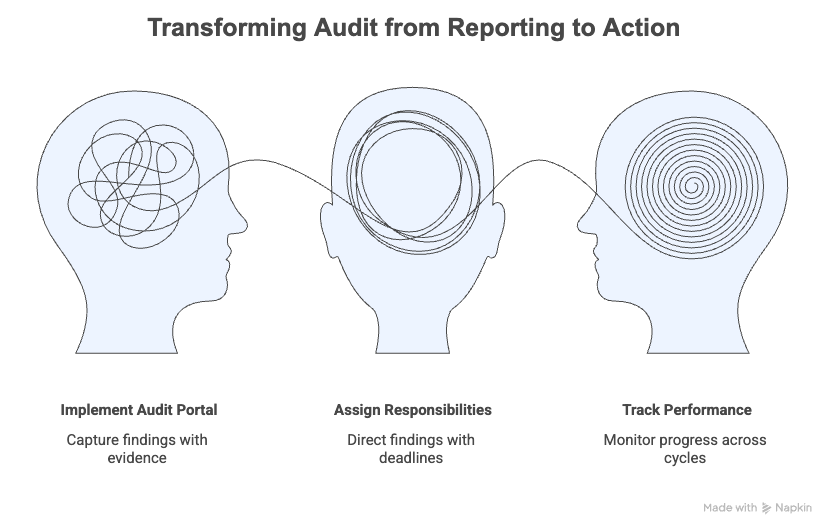
- Findings are captured when the file is reviewed, with the evidence attached — not reconstructed weeks later in a summary
- Findings go directly to the people responsible for fixing them — the adjuster, the TPA supervisor, the claims manager — with a response deadline they’ve acknowledged
- Anyone who needs to know the status of an open finding can see it without sending an email or scheduling a call
- Performance across audit cycles is tracked automatically — you can see whether the same issues are improving or getting worse without pulling together a manual analysis
- If you’re managing multiple TPAs or cedents, the data is normalized so you can actually compare them
This isn’t a technology problem waiting for someone to build the right tool. The technology exists. The gap is that the audit function has been designed as a reporting exercise for so long that nobody stopped to ask whether it needed something more.
The claims function has had a system of record for every critical workflow since the 1990s. The audit function — the one responsible for making sure every other workflow is functioning — has been the exception the whole time.
That exception has had a cost. It’s time to give the audit an address.
The Audit Portal is built to be the system of record claims auditing has never had — capturing findings as files are reviewed, tracking remediation to closure, and showing cumulative performance across every entity in your portfolio. If your audit program produces good reports but not lasting change, it’s worth taking a closer look at the infrastructure behind it.