
Most audit programs reset when a key person leaves. That’s a systems flaw, not bad luck. If the person left tomorrow, how much of it would survive?

There’s a principal Steve Jobs was demonstrating when he built NeXT that I keep coming back to.
He wasn’t trying to sell managers a more productive tool. He was encoding operational expertise directly into the platform so organizations could run better work faster, with less dependence on the people who happened to be in the building that week. The leverage wasn’t the software. It was the knowledge the software carried.
Claims auditing has the same problem. And it’s been unsolved for a long time.
The Process Is Broken Because There is No Process
Most claims audit programs aren’t really programs. They’re a collection of manual steps held together by a few capable people and a shared drive full of spreadsheets.
File lists get assembled by hand. Assignments go out over email. Scoring frameworks live in documents nobody updates. Findings land in a PDF that gets presented once and filed. The next cycle starts from scratch.
There’s no feedback loop. No accumulation. No institutional memory built into the process itself. The expertise that makes the program work lives entirely in the people running it.
That’s not a talent problem. It’s a systems problem. The process was never designed to carry knowledge forward. It was designed to produce a report. And when the process is built around output rather than operations, the result is almost always the same: findings that arrive too late, remediation that never gets tracked, and a program that resets every time something changes.
What the Process Should Look Like
A well-designed audit program doesn’t produce reports. It runs a continuous operational loop.
Findings connect to action plans. Action plans have owners and deadlines. Remediation gets tracked in the same system that surfaced the problem. The next cycle verifies whether anything actually changed and feeds that result back into how the next audit gets scored.
That loop is what separates programs that change outcomes from programs that document them. And building it requires infrastructure most organizations have never had because nobody built it specifically for this workflow.
That’s the gap the Audit Portal was built to close.
How the Audit Portal Creates The System
The Audit Portal is built around one assumption: the most valuable thing a claims audit platform can do is encode what good looks like, so the program runs at the level of your best people and doesn’t reset when something changes.
Every component is designed to carry knowledge forward, not just track activity.
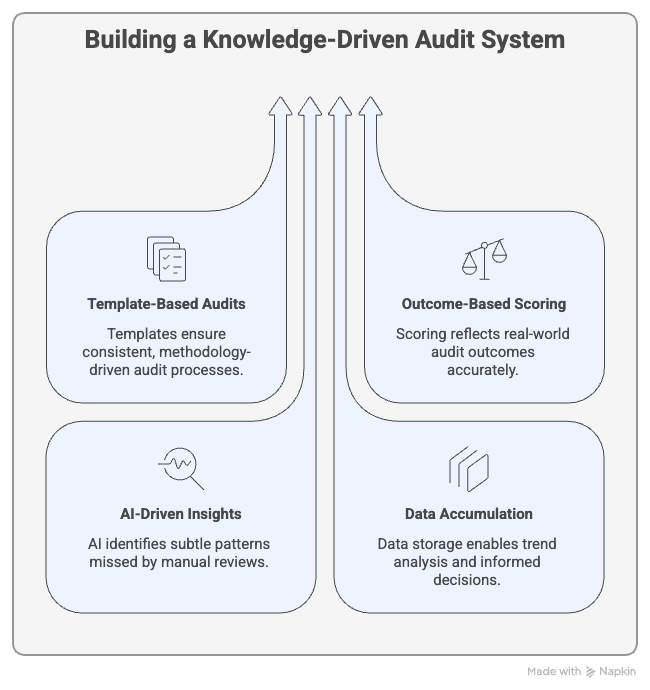
Templates built from real audit methodology. Whether you’re running an internal file QA program, a TPA performance review, or an external vendor audit, the templates reflect what matters like documentation patterns that predict leakage, reserving discipline markers, or coverage application issues that show up consistently across programs. The expertise is in the defaults. A new coordinator inherits a program that already knows how to run.
Scoring calibrated to outcomes. Most audit scoring is arbitrary an arbitrary scale applied consistently but not meaningfully. Scoring built from real audit history weights the findings that correlate with reserve deterioration, litigation rates, and operational risk. It gets more accurate as the dataset grows.
AI that identifies, not just summarizes. The Audit Portal’s AI is trained on what good claims handling looks like base on what an organization feels are the specific patterns, the red flags, the judgment calls experienced auditors make automatically. It doesn’t replace that judgment. It scales it. It creates the context for the AI to surface problems manual reviews often miss.
A system of record that accumulates. Every audit cycle generates data. Most programs don’t use it. The Audit Portal stores findings across every program, every cycle, every reviewer so patterns that showed up three years ago can inform how you score and escalate them today.
The Compounding Advantage
When the process carries knowledge forward, the program continually improves and compounds. Year one looks like a well-run audit program. Year three looks like a living methodology with trend data, remediation history, and scoring calibration built from hundreds of real cycles across multiple programs. You can’t replicate that with a better spreadsheet.
It also changes what the audit program can deliver. Real-time visibility while reviews are in progress. Reporting that’s ready when the work is done immediately not weeks later.
The organizations that build this now will have a durable advantage. Not because they hired better people. Because they stopped depending on people to carry what a system should carry.
The Question Worth Asking
Most audit programs are only as good as the last person who built them. When that person leaves, the program doesn’t evolve, it starts over.
That’s the problem. And it’s fixable, not by hiring better people, but by building a system that holds what they know.
The Audit Portal is that system. It carries the methodology, the history, and the scoring calibration forward so the program keeps getting better instead of resetting. Your best people built it. The platform carries it.
Marc Lanzkowsky is the founder of The Audit Portal, a purpose-built claims audit platform for carriers, reinsurers, TPAs, and MGAs. He previously ran audit programs through Lanzko Claims Consulting. You can follow his work at theclaimsspot.com.
[1]: The insurance industry is projected to lose approximately 400,000 workers to retirement by 2026, with an additional one million employees in the 55–64 age cohort behind them. The Institutes / The Griffith Foundation, Insurance Industry Talent Shortage, 2023. Developing expertise in complex claims roles typically requires seven to ten years of structured experience. McKinsey & Company, Closing the Insurance Talent Gap, 2022.
[2]: Claims leakage estimates vary by line of business but industry benchmarks consistently place avoidable loss at 10 to 20 percent of total incurred claims costs. LexisNexis Risk Solutions, Claims Leakage: Causes, Costs, and Solutions, 2021; Deloitte, Insurance Claims Transformation, 2022.